Body Shape is an important factor for women to get dress, according to the books & website I had read. Following is some information I collect for my project.
- Ways to find out your own body shape
One simple way is to stand naked in front of your mirror, look carefully to yourself, learn about your bustline, waistline, hipline, mid-thigh, knee length and ankle length.
Another way is to ask your friend to photograph you front, back and sideways. Then you can look into the picture and discuss with your friend.
Of course, your can also ask your friend to give you some honest opinion.
- Different types of body shape
According to
Style Makeover HQ, you can classify your height. If you are less than 160cm and without large body scale, you may call yourself Petite. In Jay Calderin's book, she argues that women mature figure height is 1.65-1.68m, and petite height is 1.57-1.63m. I think this difference is not a great deal.
This is Style Makeover HQ's method of Identifying women's body shape.
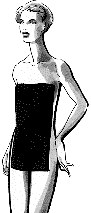
Hourglass Figure is a lucky shape, the body vertical shape is balanced, and the bustline and hipline are the same width, and the waist is well defined.
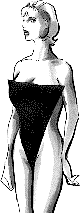
Of this nice body shape, you might have a large bust or broad shoulders, narrow hips with well defined waist, mostly long and slim legs, maybe a flat bottom.
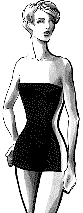
You are with this body shape if your bustline is narrower than your hipline, and you have a well defined waist, typically a narrow shoulders, balanced or short legged, full thighs and round bottom.
Rectangle shape is typical for their bustline and hipline are the same width, little waist, slender legs and arms, small to medium bust, balanced or long legs, flat bottom.
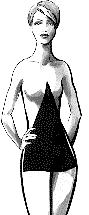
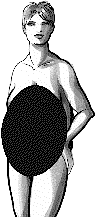
This body shape is similar to apple. They have undefined waist line, wide hips, large stomach, and full bottom.
- Dress according to your body shape
Here's some suggestion for getting dress for each body shape.
Hourglass Do:
- Fitted and semi-fitted clothes
- Soft, clingy, flowing fabrics
- Low to medium-low necklines
- Dresses with defined waistlines
- Straight and gently flared pants
- Straight and gently flared shirts
Hourglass Dont:
- Stiff, bulky, fabrics
- Baggy styles
- High necklines (unless you have a small bust)
- Skirts with open pleats
- Very tapered pants
Inverted Triangle Do:
- Flowing fabrics
- Low to medium-low necklines
- Set-in sleeves
- Three-quarter length sleeves
- A good fitting, well adjusted bra
- Tops and dresses that flow through the waist
- A-line skirts
- Flared pants
Inverted Triangle Dont:
- Stiff, bulky, fabrics
- Styles that emphasize your shoulders
- High necklines
- Big collars
- Tapered skirts and pants
Triangle Do:
- Accessories and designs to draw attention to your upper body
- Short-sleeved tops
- Shoulder pads to broaden your shoulders. This may sound very 80s advice, but they really do work. However, they should not be visible
- Medium to high necklines
- Garments to emphasize your waist
- Skirts and dresses that are straight or slightly flared
- Low rise pants to avoid gaping at the waist
- Boot leg and straight pants
Triangle Dont:
- Baggy garments
- Stiff fabric
- Garments that add bulk to your hips
- Hems or design lines at hip-line
- Open pleats on skirts or pants
- Tapered skirts or pants
Rectangle Do:
- Shoulder pads to emphasize your shoulders. This may sound very 80s advice, but they really do work. However, they should not be too large and definitely shouldn't be visible
- Semi-fitted clothes
- If you have firm upper arms, short-sleeves and sleeve-less tops and dresses
- Medium to high necklines
- Dresses that wrap or flow through the waistline
- Straight to gently flared flat-fronted pants
- A-line shirts
Rectangle Dont:
- Clingy fabrics
- Fitted clothes
- Low necklines
- Baggy tops
- Baggy pants
- Narrow skirts
Oval Do:
- Ear-rings, necklaces and other focal points designed to draw an observer's eyes up towards your shoulders and face
- Shoulder pads to emphasize your shoulders. This may sound very 80s advice, but they really do work. However, they should not be be visible
- Semi-fitted and loose fitting clothes
- Good fitting, well adjusted bras
- Support underwear
- Tops and bottoms in the same colors
- Low necklines
- Un-tucked tops
- Tops and dresses that flow through the waistline
- Straight flat-fronted pants in soft, flowing fabric
- Straight and slightly flared skirts
Oval Dont:
- Clingy fabrics
- Fitted clothes
- Fabric with large patterns
- High necklines
- Large lapels
- Belts
- Tucked-in tops
- Pleats
- Narrow or tapered skirts
- Narrow or tapered pants
Reference:
1. Kim Johnson Gross and Jeff Stone(1998) What Should I Wear? London, Thames and Hudson Ltd.
2. Sophie Woodward(2007) Why Women Wear What They Wear. Oxford, Oxford International Publishers Ltd.
3. Jay Calderin(2009) Form Fit Fashion. United States of America, Rockport Publishers, Inc.
4. Simon Traves-Spencer and Zarida Zaman(2008) The Fashion Designer's Directory of Shape and Form. London, Quarto Publishing plc.
5. Style Makeover HQ(n.d.) What's Your Body Shape? [Online] Available from:
http://www.style-makeover-hq.com/body-shape.html#top [Accessed 21st Nov. 2011]